

In this article
- So, what does a keynote speaker actually do?
- Is a keynote speaker the same as a motivational speaker?
- What makes a good keynote speaker?
- A good keynote starts with the audience, not the speaker
- Why do organisations hire keynote speakers?
- When should you book a keynote speaker?
- What should you tell a keynote speaker before the event?
- How do you choose the right keynote speaker?
- What is the real purpose of a keynote speaker?
It sounds like a straightforward question, doesn’t it? Someone walks onto a stage at a conference, talks for 45 minutes, everybody applauds politely and then heads off in search of coffee and something involving a pastry.
Well, technically, perhaps. But if that’s all a keynote speaker does, I’d suggest somebody has rather missed the point.
I’ve spent a sizeable chunk of my working life speaking at conferences and events in the UK and around the world. Over the years I’ve shared ideas in more than 40 countries, working with organisations large and small, in both the public and private sectors.
And for me, the job of a keynote speaker isn’t simply to give a speech. It’s to help the people in the room see something differently. Perhaps that’s how they respond to change. Perhaps it’s how they lead, communicate, build resilience, deal with pressure or get the best out of themselves and other people.
And ideally, when the applause has died down and the conference lanyard has eventually found its way into a kitchen drawer, something from that talk is still proving useful.
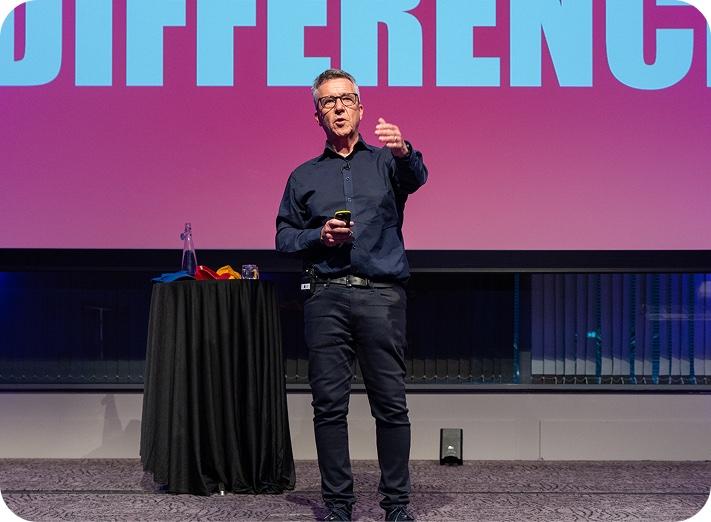
A keynote speaker is the main speaker at an event, brought in to set the tone, explore a central idea and give the audience something useful to think about or act on afterwards.
So, what does a keynote speaker actually do?
The clue is in the word keynote. A keynote speaker is normally there to help establish or reinforce one of the key themes of an event.
That could be a message around leadership, organisational change, resilience, performance, culture or communication. The subject will vary, but the challenge for the speaker is much the same: take an idea and make it relevant to the people sitting in the room. That’s easier said than done.
We live in a world where nobody is particularly short of information. In fact, quite the opposite. Most of us are being bombarded with it from the moment we wake up. So I don’t think the job of a keynote speaker is to add another mountain of facts to the pile.
In How to Succeed with People, I write about one of the common mistakes people make when trying to communicate: drowning people in detail. We can convince ourselves that the more information we give somebody, the more persuasive we’re being. Often, we’re simply making it harder for them to understand what actually matters. The same applies on stage.
A good keynote speaker should bring clarity to the clutter.
That doesn’t mean making everything simplistic. Some issues are genuinely complicated. But it does mean helping an audience leave with a clearer way of thinking about the issue than they had when they arrived.
Is a keynote speaker the same as a motivational speaker?
Sometimes. But not always. A motivational speaker is usually brought in primarily to inspire, encourage or energise an audience.
A keynote speaker may absolutely do those things too, but the role can be broader. They may be there to challenge an organisation’s thinking, introduce a practical framework, help people make sense of change, address leadership behaviours or give people tools they can use when they get back to work.
Personally, I’ve always been slightly wary of inspiration on its own. It can feel wonderful in the room. Everyone is fired up, people are nodding enthusiastically and for a brief moment we all believe Monday morning is going to be completely different.
Then Monday morning actually arrives. The inbox is full. Somebody has booked a meeting you don’t want. The printer has apparently resigned from active service. And suddenly the inspirational quote on the conference screen feels a little less powerful.
That’s why I’ve always tried to make my own work practical. I want people to think and feel differently, certainly. But I also want them to leave with an idea, question or tool they can actually use. That, for me, is when a keynote becomes genuinely valuable rather than simply enjoyable.
What makes a good keynote speaker?
Clearly, being comfortable on a stage helps. But confidence alone doesn’t make someone an effective speaker. I think some of the best keynote speakers do three things particularly well: they make ideas clear, they make them memorable, and they make them relevant.
Stories play a big part in that. When I revisited SUMO for its twentieth anniversary, I reflected on something a mentor had told me years earlier. He encouraged me not simply to share ideas and successes, but to share the struggles too. He was right.
People connect with stories because they recognise something of themselves in them. We may have different jobs, backgrounds and experiences, but we all know what it feels like to doubt ourselves, get things wrong, experience disappointment and occasionally wonder what on earth we’re doing.
That’s why I think a good keynote should feel human. Not polished to the point where the speaker appears to have lived a flawless existence since birth. Not 47 minutes of heroic achievement followed by a photograph of them standing on a mountain. But something real.
A story can open the door. Then the idea can walk through it.
A good keynote starts with the audience, not the speaker
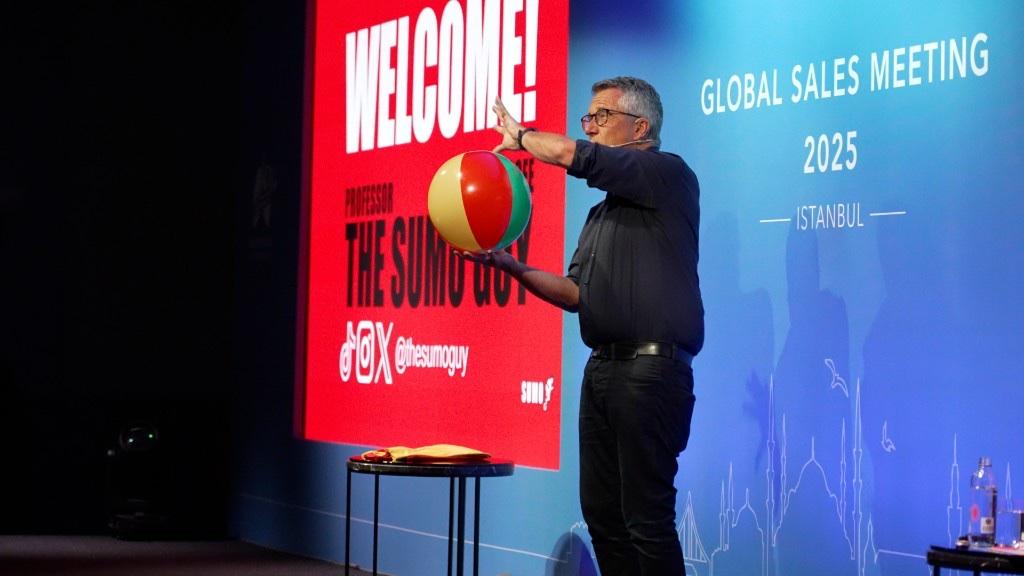
There’s one SUMO principle I think is particularly relevant to speaking: Remember the Beachball.
Imagine a beachball between two people. You may be looking at the red section while the person opposite you is looking at the blue one. You’re both looking at the same ball. You’re simply seeing it from a different perspective.
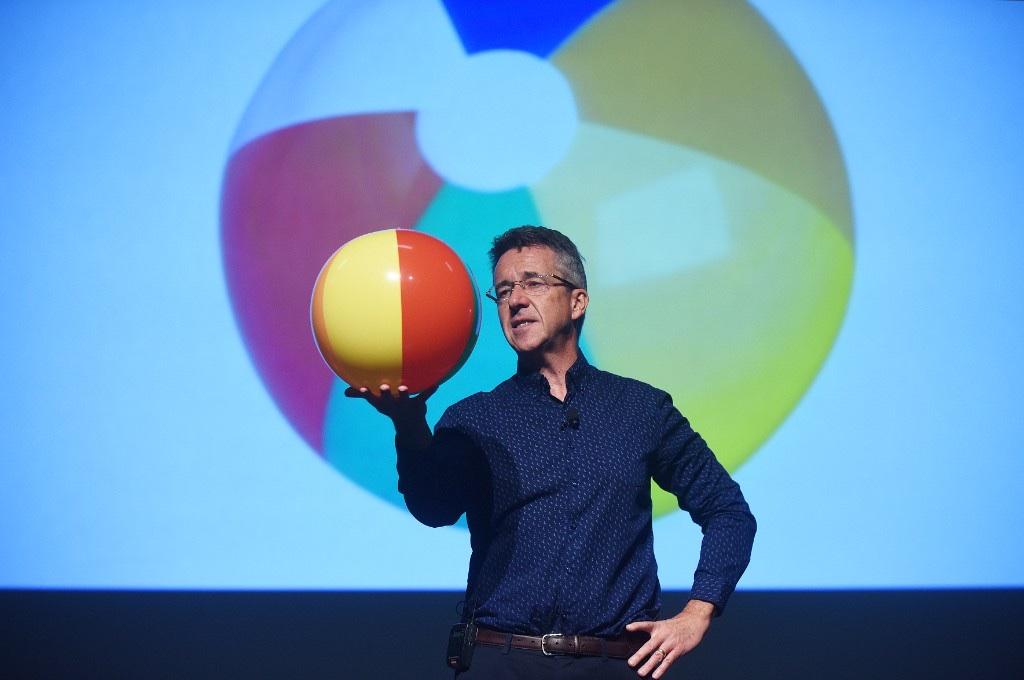
In SUMO, the principle is about recognising that our age, values, personality and current state of mind can all influence the way we see a situation. Understanding somebody else’s perspective does not mean automatically agreeing with it, but it does make better communication far more likely.
The same principle matters when speaking at an event. The speaker has their world. The audience has theirs. The job is to connect the two.
What is happening inside that organisation? What have people recently experienced? Are they excited about change, exhausted by it, or suspicious of anything containing the words “new strategic direction”?
Who is actually in the room? Senior leaders? Frontline teams? Salespeople? HR professionals? Five hundred people who have just been told there’s a compulsory breakout session after lunch?
Context matters. A keynote shouldn’t feel as though the speaker could have delivered exactly the same talk yesterday to a completely different organisation and will be delivering it again tomorrow with nothing changed except the logo on the first slide. The audience should feel understood.
Why do organisations hire keynote speakers?
Sometimes an organisation benefits from hearing an outside voice. That doesn’t mean its own leaders lack good ideas. Quite often they’ve been communicating some of those ideas for months.
But familiarity changes the way we hear things. Someone external can sometimes express an idea in a fresh way, challenge assumptions or simply create enough distance for people to consider something differently.
A keynote can be particularly useful when an organisation is:
- going through change
- trying to build resilience
- developing its leaders
- bringing people together after a difficult period
- changing its culture
- looking for better ways to communicate and perform
And sometimes it’s simply helpful to stop. Most organisations are busy. People move quickly from one deadline, project or meeting to the next. A good conference or keynote creates a bit of space to pause and reflect. That can be surprisingly valuable.
One piece of feedback I particularly like came from an NHS event where delegates were apparently already using some of the questions from the session during the conference itself. That’s the kind of response I’m interested in.
Not simply: “That was a good speaker.” But: “I’ve started using that idea.”
When should you book a keynote speaker?
I’d start with a different question: Why are you considering one?
If the answer is simply, “Well, we normally have a speaker at the annual conference,” I’d probably dig a little deeper. What do you want people thinking about differently? What do you want them talking about afterwards? Is there a particular challenge the organisation is facing?
Perhaps people are dealing with uncertainty. Perhaps the organisation is changing and some people are struggling with it. Perhaps managers need to communicate better. Perhaps teams have become disconnected. Perhaps people are under pressure and resilience has become an issue.
The clearer you are about the outcome, the easier it becomes to choose the right speaker. The event should shape the speaker choice. Not the other way around.
What should you tell a keynote speaker before the event?
As much useful context as you can. Tell them who is going to be in the room. Explain what has been happening in the organisation. Tell them what has gone well and what hasn’t.
Tell them what the audience already knows. Tell them what they’re tired of hearing. Tell them about the language people use internally.
And if there’s an elephant in the room, it’s generally better that the speaker knows about the elephant before walking onto the stage and accidentally tripping over it.
This is especially important around change. In How to Succeed with People, I explore why the statement “people don’t like change” is far too simplistic.
We’re often perfectly happy with change when it’s our choice, when we feel some control over it, when we can see the benefit and when we understand the downside of staying where we are. It becomes much harder when change is being done to us.
That’s why context matters enormously. Two companies can both say they are “going through change” and be experiencing completely different realities. A speaker needs to understand which one they’re walking into.
How do you choose the right keynote speaker?
There’s an understandable temptation to begin with the biggest name you can afford. Sometimes that works brilliantly. But profile and relevance are not the same thing.
A famous person may attract attention and create excitement around an event. That can be valuable. But I’d still begin with the audience.
What do they need? What is the theme? What is the challenge? What kind of style will work for them?
Do you want somebody who is primarily inspirational? Someone practical? Someone provocative? Someone funny? Someone highly academic? Or perhaps a mixture of several of those things.
Then look at the speaker. Do they have genuine experience or expertise around the subject? Can they communicate it in a way this audience will understand? Do their ideas appear useful beyond the stage?
And perhaps most importantly, are they interested enough in your organisation to adapt what they do?
Because you’re not really buying 45 minutes of somebody talking. You’re trying to create an experience that matters to the people in the room.
What is the real purpose of a keynote speaker?
For me, it comes back to something quite simple. A keynote speaker should help people pause long enough to think differently.
They should bring clarity rather than clutter. They should make useful ideas memorable. They should understand that speaking is not about impressing an audience with everything they know. It’s about helping that audience with something they need.
And ideally, people should leave with more than a photograph of the stage and a notebook containing three enthusiastic sentences they never look at again.
The real test comes later. Did anybody remember the idea? Did they use it? Did they have a different conversation because of it? Did anything actually change?
Because applause is lovely. But impact is better.